Tutorial
IDE 712
Assignment: Learning Hierarchy Analysis
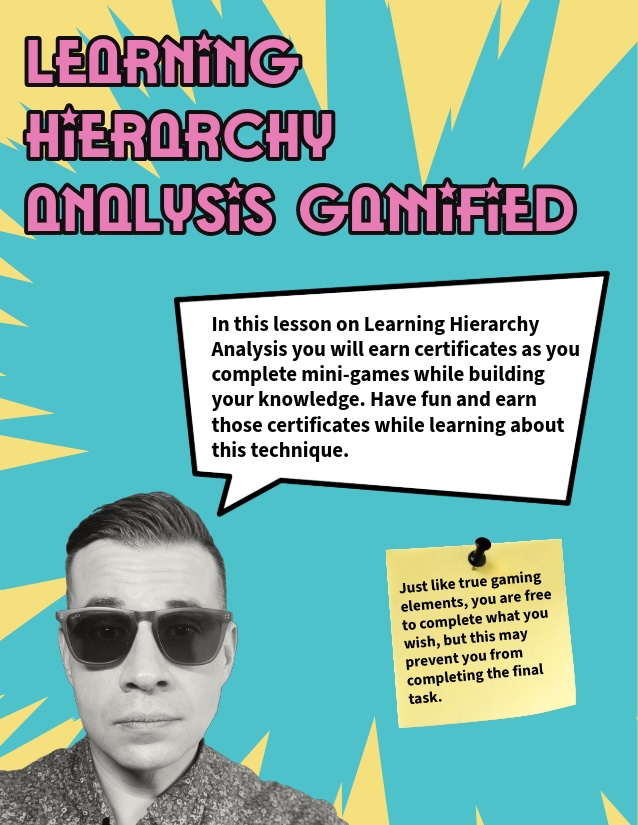
When developing instructional objectives it is imperative that the prerequisite skills to perform those objectives are identified. An instructional designer must know what must be learned in order to develop instruction. This happens by identifying the required lower-level skills that lead to higher-level skills for completion of objectives. Learning Hierarchy Analysis is this process. To explain the process, IDE 712 required that I develop a lesson on Learning Hierarchy Analysis. I chose to utilize the gamification instructional strategy that was introduced in IDE 611 to build my lesson. This is a strategy I have seen used with teenage boys who were self-identified gamers. I also have experience developing playable video games with students. I saw the potential of a perfect union between Learning Hierarchy Analysis and the gamification strategy because games use Learning Hierarchy Analysis to educate their players. If Nintendo did not ease its players into games such as Zelda by building skills that a player needs to be successful, Zelda would not have many modern players. Gamification felt like the best way to represent Learning Hierarchy Analysis in my instruction.
It was important that the design and development of this lesson follow the gamification strategy. True gamification of learning allows the learner to explore as they please and build their learning through that exploration. My lesson did not require learners to follow a linear progression. However, if you did not complete all tasks, you may fail the summative evaluation. I also included formative evaluation throughout the lesson. These learning checks were important for the learner to reflect on the knowledge they were building towards the summative assessment. I even included a self-assessment in the form of selecting a Yay or Nay for how the learner was feeling. To keep with the gamification concept, learners can collect certificates throughout the lesson as an incentive. I built this game using the Interacty online application. I have also used the Interacty application outside of my IDDE courses when I taught First Year Seminar to first year students at Syracuse University.
This was another opportunity to be creative by designing and developing instruction. We could have presented this instruction in any way we wished, but I wanted my instruction to be interactive and use different media. Thinking about my learners, the learning would be done asynchronously, and it is possible there could have been presentation burnout. Gamification is a fun interactive learning strategy. It is not what motivates people to learn, but a platform to deliver instruction. This project reaffirmed my desire to learn more skills to build even larger in-depth products for instruction through gamification. I can visualize an entire series of games to get students invested in new ideas and encourage them to explore new learning opportunities.
 David Stablein Instructional Designer